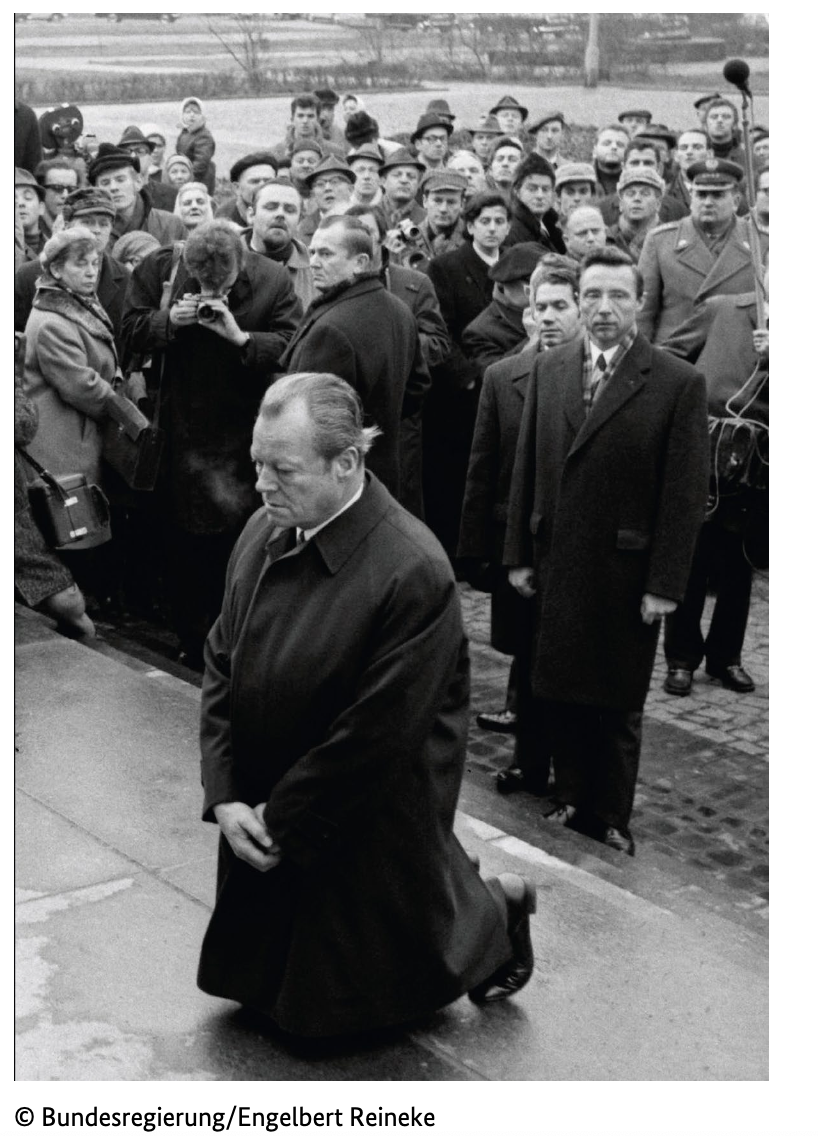
181. What did Willy Brandt seek to express with his genuflection (Kniefall) in 1970 in the former Jewish ghetto in Warsaw?
Official German wording
Was wollte Willy Brandt mit seinem Kniefall 1970 im ehemaligen jüdischen Ghetto in Warschau ausdrücken?
Answer options
Correct answer
He asked Poland and the Polish Jews for forgiveness.
Explanation
The so-called Warsaw Genuflection (7 December 1970) at the Monument to the Ghetto Heroes was a symbolic plea for forgiveness and a public acknowledgment of German guilt toward Polish victims and Polish Jews. It formed part of Ostpolitik and the 1970 Treaty of Warsaw, which recognized the Oder–Neisse border under international law, and aimed at political reconciliation. In constitutional terms, the gesture resonated with the Basic Law’s normative break with Nazism and the primacy of human dignity (Art. 1(1) GG). It was a moral-political, not a legally binding confession of liability, yet it marked a watershed in Germany’s culture of remembrance and was recognized internationally, including by the 1971 Nobel Peace Prize.
Official sources
The German questions come from the original BAMF catalog for the Einbürgerungstest and Leben in Deutschland. Translations and explanations are study aids; verify legal details in the official sources.